Showing posts with label Case Study. Show all posts

Wednesday, February 24, 2021

Random Musings: On Wilson Global (WGB) and the genius of bonus options


One of the long term holdings in my portfolio is Wilson Global (WGB) which is an LIC (listed investment company) run by Geoff Wilson, the legendary CEO of Wilson Asset Management. Prior to the big crash in Feb 2020, I had a small holding which I had gradually bought into as it went down and through the recovery. 


It has since become my best performing investment, vastly outperforming the Australian market and recent developments have made it into one of the more interesting ones too. 

On the 10th of February, an announcement went out which gave every WGB holder an option to purchase an additional WGB share without brokerage fee, to be exercised at any time until expiry on 12 September 2022. Early exercise of these options also comes with the benefit of dividends as they become due.

Compared to the standard capital raising process of issuing new shares, there are a lot of reasons why this is far more favourable. In the standard issue of new shares, they would need to be offered to the broader public at a price that is lower than their current value, otherwise there would be no incentive for new purchases. This in turn dilutes the current shareholders by reducing the price of their holding. On the other hand, the option issue that WGB has introduced provides less certainty about the quantum of capital to be sourced, however it keeps shareholders happy as only they are the ones who hold the power to dilute their own shareholdings.

As someone who has spent a bit of time dabbling in the theory of options trading, but never bought any personally, it provides me with a nice introduction into the derivative. Simply speaking, once the options have been issued to me, there are three choices I can make:
  • Purchase further shares at $2.54 per share
  • Sell the option to purchase
  • Do nothing and let the options expire worthless.
As I write this post, WGB is currently trading at $2.63. It would be expected that when the option does get issued, there would be a reduction in share price to the value of the option, however just for educational purposes, I found an online options pricing calculator which utilises the Barone-Adesi And Whaley pricing model for American options gives an indication as to what each option would be worth:


The issue of these options provides me with a first taste at hands on experience in decision making with call options at no upfront cost to myself. In all likelihood, I will probably end up selling the options rather than exercising them, but picking the right time will be paramount and the tax implications will also be interesting. Exciting times ahead.

By 小福

Sunday, February 7, 2021

Case Study : GME and WallStreetBets the Game that Stop(ped) the whole world

Readers may note that it has been a short while since I have updated this blog. This has been largely brought about by two factors:
  • The idea that houses are going to outperform stocks in the short to medium term due to the yield of cash flow from property given the risk profile, which has resulted in my spending the last several months doing numerous house inspections and dedicating a considerable amount of my waking hours to sourcing an investment property.
  • Nothing much had been happening on the stock market
The key word in the second sentence is of course "had". Anyone who has been keeping up with the news of late has of course heard of the Gamestop Wallstreetbets saga and I thought had though that it would be good to wait for the day to day drama to blow over before commenting on it. With the situation calming down a bit, I am finally able to put my "pen" to "paper" and provide my opinion on the last several weeks. 


Before we begin though, some context:

What is GME

Gamestop is an American game retailer with a focus on electronics and consumer electronics sold through their bricks and mortar stores. Founded back in 1984, it was one of the world's largest video game retailers, Australians would recognize their subsidiary EB Games as a regular in large shopping centres. As you would imagine, through the transition to digital rendition of games and the subsequent lockdown, GME has been gradually reducing in price through the years. 


Rise, Short Squeeze and Subsequent Decline

Our story starts with a redditor by the name of Keith Gill who goes by the username r/DeepFuckingValue, reflecting his perchance for value stocks which have been underappreciated by the general public. In September 2019 (when GME was trading at around $5) he purchased a $53,000 position in GME as he believed that it was a value purchase that would eventually rise back up to fair value. Making numerous youtube and reddit posts about the subject. This eventually lead to other posters doing their research on the stock and realisng that GME was one of the most heavily shorted companies with roughly 140% of their public floated stocks being shorted. This means that some of the already borrowed shares were loaned out again to short. One of the biggest holders of these shorts was none other than Melvin Capital, one of Wall Street's best performing hedge funds. 

This prompted a considerable amount of online discussion pertaining to a potential short squeeze whereby highly shorted stocks would have to be brought back at higher prices to stop the losses they had accumulated from their positions, which would of course have lead to an even higher price (for those interested, the VW squeeze of 2008 is a good reference). With this in mind, the masses of retail investors at r/WallStreetBets took up the cause and bought vast amounts of GME, pushing the price from $20 per share up to $483 fueled by a desire to make some tendies and for some, a crusade to make the hedge funds and Wall Street pay for the pain they had caused in the GFC. Of course this had captured the attention of not only stock traders in America, but the whole world. It would have been no understatement to say that the sentiment on r/Wallstreetbets was euphoric:


The fallout from this was significant, with Melvin Capital announcing losses of 53%. Shortly after, brokerages such as RobinHood and IG limiting purchases of GME stock as well as others such as BB, AMC and NOK which had also been pumped in the same manner, the response was furious with other subs such as r/stocks, r/investing and r/options banding together in their castigation of the institutions preventing retail investors from exercising their right to purchase, notably it also briefly united both the left and right aisles of the political spectrum in their condemnation.

Peak frenzy occurred on the 29th of January which happened to be a Friday. The weekend that ensued was filled with misinformation at best and corruption and conspiracy theories for those who are more cynical. R/WallStreetBets subscribers ballooned from around one million to over six million with proven infiltration by bots as well as opportunists who tried to take command of the situation and pump other penny stocks as well as SLV. Their discord server was shut down temporarily on allegations of hate speech and the SEC had announced that they would be actively monitoring the sub for allegations of market manipulation. 


Since the opening on the Monday after, the stock has seen a fairly sharp decline in price despite cries by alleged shareholders to "hold the line". As it currently stands, GME trades for roughly $60 and shorts are still estimated to be at 100% of the stocks, indicating that the squeeze had yet to occur, but the stock holders on r/wallstreetbets appear to be quite despondent and the prices seem to have stabilised to a moderately slow decline.

Discussion

I've spent the last week or so reading quite a few analytical pieces to try to draw some conclusions on what happened, which I will put briefly:
  • In the end, the stockmarket is just that, a market. It is a place for individuals to buy and sell stocks for profit, nothing more, nothing less. Those who wish to use the market to be a weapon of sorts to launch a crusade against the hedge funds for their behaviour during the GFC should reconsider their motives. Even if Melvin went into liquidation, there are still hundreds, if not thousands of hedge funds that are willing and able to take up the void that Melvin created. Rather than trying to take down hedge funds by way of pumping stocks that have been shorted, retail investors should consider that it was the government who made the decision to bail out the hedge funds and the government who offered such a lack of regulation on the industry which caused the fiasco to begin with.
  • When the romanticism of taking down the institution is stripped away, this case study is one of a textbook pump and dump on the part of redditors. From the outset, u/DeepFuckingValue has been a self proclaimed value investor who saw the arbitrage between the value of GME and the price in which it was trading for. He had purchased this through both fundamental and technical analysis. Those of whom purchased GME at $300 after it had made headlines around the world were obviously too late. There was no justification at all to be buying the stock for a price which outpaced fundamentals completely, and as we will have seen, those shareholders are the ones who were left with considerable losses. In the end, it is never wise to join in herd mentality and buy what everyone is buying unless you have a firm conviction of why it will go up as well as an exit strategy.
  • This case study has proven that social media is an influence in the markets which had, until now, not been factored into traditional risk analysis. Suffice to say, this will definitely have to be captured into any such calculations. 
For those wondering,  I didn't purchase any GME, nor do I intend to dabble in the US market whilst prices are as they currently stand, but it was an extremely exciting rollercoaster to watch, even on the sidelines.

by 小福

Sunday, August 16, 2020

Maths: On maintaining or increasing dollar cost average

Have taken a short hiatus since my last post. With the February March crash well and truly behind us, the last two months in the market have been extremely flat. Long gone are the days of extreme volatility and since mid June, not much has really happened. This is clearly evidenced in the below chart:


As I write this, the ASX stands at 6126 points, a good 15% below the all time high of 7199. Although the S&P 500 has since reached all time highs and NASDAQ has long surpassed it, the ASX remains steady at around the 6000 to 6100 mark.

Given what had happened in February and March, ボーイフレンド had been a strong advocate for investing more and more the greater the deviation from all time high. At the bottom of the market, he was putting in 16 times his usual investment amount on a monthly basis, and then gradually scaling back as the market recovered. Where we are now, he is still putting in 4 times the usual, which has obviously impacted on cash reserves. With my limited resources, I am also putting in double what I would normally invest into the market. This has obviously resulted in fairly good returns for the both of us, he has long recouped all losses whereas I am roughly breaking even, even though the local market is still significantly lower than it was.

This brings me to current day, where we have fluctuated around this mark for about two months and I had been pondering whether or not to reduce our contributions given it had been eating into our cash reserves and that some developed countries had opted to go into lockdown again given second wave covid.

Essentially the dilemma I was facing was as follows:

  • If I keep contributing a greater amount than usual and the market crashes or suffers a correction due to second round lockdowns or other unforeseen circumstances, the funds I had invested in the market would be hit and I would also have a significantly lower cash reserve to throw into the market to get the benefit of better value shares.
  • If I reduced my contribution to my original standard amount, even though the market stands at 15% lower than all time high, and a crash does not occur, the cash I hold in the bank will be making negligible returns and whatever I do not invest now will have to be invested at a later date where the prices may have inflated considerably.
In pondering what to do with this conundrum, he mentioned the utility in working it out via outcome matrix given the range of potential situations and our three variables:
  • Increased or standard contribution
  • Depth of crash
  • Potential of crash
We worked this out using the following simulation. Whilst the current Australian CAPE stands at 19, there was no consideration for us to cash out any of our holdings, which meant at least one less factor. Assumptions we made in the following examples are as follows:
  • Standard contribution is $5,000 per month, increased contribution is $10,000 per month
  • Where the market doesn't crash, it goes up by the annual amount of 10%
  • Starting portfolio is $0 as what is already in the market is irrelevant.
Outcomes of our simulations are as follows:

Allowing for a 40% crash in 3 months


Allowing for a 30% crash in 3 months


Allowing for a 20% crash in 3 months


From the results, it can be easily distilled that the lower the chance of a crash, the better it is to go in with a higher contribution so as to maximize returns on cash. By putting these numbers into the matrices provides a quantifiable outcome for either scenario, thereby allowing me to consider which course of action I ought to take.

With the Australian Market pricing in zero profits across the board for the future year and a half (using CAPM and DCF models given risk free rates), it is fairly safe to say that the odds of a significant correction in the market is lower than usual, provided a Republican win in the Presidential Election in USA. Given the above modelling definitively shows that there is a strong reason to continue to contribute aggressively to the market whilst prices are still at their current rates.

by 小福

Friday, April 17, 2020

Case Study - BBUS and BBOZ: The First One's Always Free

Those who have been dabbling in stocks during the most recent period of volatility will undoubtedly have gained invaluable experience in the market during the Feb to April downturn and subsequent uptick. In summary, from 19 Feb to 23 Mar, the S&P 500 lost 33.9%, making it the fastest crash in history. This was followed by growth of 17.5% from 24 to 26 Mar, being one of the biggest three day gains for almost a century. It would not be an exaggeration to say that what we lived through was truly extraordinary. What was even more amazing was to watch the market response to these violent movements. 

As my readers will now have discerned, my investment strategy has been a fairly conservative one where I dollar cost average twice a month, largely into index funds and by exception individual shares where they appear to be of exceptional value and worthy of the additional risk involved. Whilst I stuck to my plan throughout, I have found it to be infinitely fascinating to watch the response of average retail investors who succumbed to the dark side and were burned hard by the market. 

In observing the people around me and a plethora of online forums, there were two main poisons which decimated portfolios, one was Put Options, the other was Inverse Indices. Today's topic of discussion will revolve around two highly popular inverse indices, BBUS and BBOZ. 

 
The simple way to explain inverse indices is that it is exactly what the name purports, an inverse of an index fund. While BBUS is a leveraged inverse of the S&P 500, BBOZ is a leveraged inverse of the ASX 200. By utilising futures contracts, every 1% lost in the relevant index results in a 2% to 2.75% gain for the holder. As you can envisage, this became a highly attractive investment vehicle to make some gains during the intense drop. Although it may sound like a good idea to buy when the market is falling, there are a number of reasons why a beginner or even novice investor shouldn't touch these products.

Market Timing

When you buy into index or a fairly stable blue chip share, it is almost an inevitable outcome that the shares will go up in the long run. Since BBUS and BBOZ are inverse indices, they obviously go down in the long run as demonstrated in the chart below.


When you look at the prices for BBUS in the last several months the returns look extremely attractive after the fact. If you bought on 20 Feb for $2.67 per unit, this would have become $6.63 by 23 Mar. However, given the state of the economy on 20 Feb, who would have been able to foresee the impending crash and buy into BBUS? Very few. Given the uncertainties surrounding the impacts of coronavirus on the economy and subsequent fall out, most people held onto their portfolios for at least several days until a downward trend was established when it was somewhat higher in price. I know of at least one friend who put their whole portfolio into BBUS at peak for $6.63.

Given investor psychology surrounding the Dunning Kruger effect, even the investor who bought in at the peak was determined that the falls were not yet over and any minor dips constitute bear market rallies and the big crash has yet to come. Of course the media also fanned flames during this period, hyping up death stats and forecasting the end of civilization as we know it, but the unsavvy investor failed to realise that this was already priced in when the market tanked. As a result of this, they consistently held on whilst their portfolio was was violently wiped out.
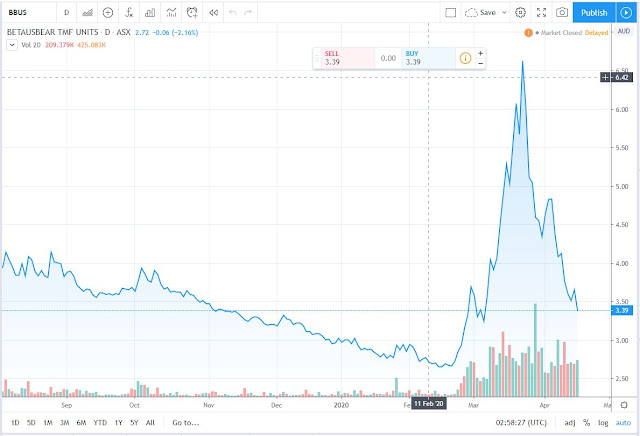

As of today, BBUS currently stands at $3.39, almost down to what it started on. Are we in the middle of a massive dead cat bounce and the big crash is still coming, or whether we are in for a V shaped recovery? I don't know, which is why I will continue with my dollar cost averaging. Short of being able to accurately time future market movements, it would be imprudent to purchase such a risky vehicle. Having said that, if you are able to accurately foresee the future, why wouldn't you just maximize your gains on minimal cost by buying next week's lotto ticket and min maxing your profits.

Compounding Risk aka. Volatility Decay

Another reason why leveraged inverse indices shouldn't be held for an extended period of time, but isn't apparent to most until demonstrated by a worked example.

For simplicity, let's do two worked examples on the following parameters:

  • Starting portfolio is $10,000
  • Every day the market moves up or down 1% (10% in the other simulation) returning to parity every second day
  • For simplicity we will take the leverage of inverse index at a multiple of 3.


As you can see, whilst market returned to parity every second day, the value of the portfolio was gradually reduced, whilst the results were subdued when volatility was small, when movements were violent, decay was also extremely brutal. Given the fluctuations of the last several months, I have no doubt that quite a few people suffered considerable losses from volatility decay.

For further clarity, consider the fund strategy that BetaShares proposed for both BBUS and BBOZ whereby returns of 2% to 2.75% for every 1% drop are only for any given day, thereby indicating that those returns cannot be expected to continue for periods over one day.

Expenses

Due to the nature of inverse indices attaining their benchmark leveraged returns through use of complex mechanisms like derivative contracts, the associated expenses of high fees, high transaction costs and re-balancing costs also eat into returns considerably. Although simple, for someone who puts money into ETFs for their low management costs, this is clearly reason why inverse ETFs should be considered with a grain of salt.

Conclusion

The last months have provided me with precious insight into the workings of the human mind and how the fear of loss coupled with greed to make gains have pushed innumerable investors to the dark side. From moderate gains during the remainder of the bear market to the eventual wipe-out with the recent rally, millions have been lost on the market because The First One's Always Free and the lure of quick gains is intoxicating. For this, I am grateful to have held firm to my resolve and weathered the storm.

It has also provided a practical example to ボーイフレンド as to why retail investors often under perform when compared to index returns.


As a final point, for those who are wondering. Mr A, who got bored of checking on his brokerage account and continued to DCA through the dip on a preset diversified spread has now returned to -13% on his portfolio whilst the market is still at -20% from peak, outperforming everyone that I know personally.

By 小福

Monday, April 6, 2020

Case Study: On UNV, TER and margin of safety

One highly technical post calls for another. I hadn't intended to go into another so soon but due to the recent chain of events, it was too good an opportunity to pass, so today's post will be on the complete debacle that was TerraCom's (ASX: TER) purchase of Universal Coal (ASX UNV). In the words of ボーイフレンド it was basically a murder suicide with retail shareholders forming unwitting collateral damage. 

All good stories though, start from the beginning. So that's where we will commence. Late last year ボーイフレンド was considering industries that would be likely to outperform in the medium term. With a fairly contrarian perspective compared to the average retail investor, he decided that with the uprising popularity of renewable energy and the social pressures surrounding ethical funds, traditional fuel sources like coal and oil would be fairly discredited and undervalued in the short term. As a result of this, he and Mr D started looking into individual companies in the industry for potential individual picks for investment. 


In their research, they came across UNV, a London based Thermal Coal company with operations in South Africa. One look at their financials shows why it was such an attractive company to buy into. With steady growth in revenues, reasonable and proportionate expenses, healthy cash flow, a history of generous dividends as well as excellent asset to liability ratios whilst management also appeared to be sound. In applying discounted cash flow models to value the shares, ボーイフレンド determined that each share was worth within the vicinity of 0.6 to 0.9 which obviously meant that his purchase price of 0.24 when the PE was about 5 (and my subsequent purchase at 0.23) was definitely a steal, so we purchased a small amount of holdings each.

For reference, I have extracted some financials of UNV current as of 6 Apr 2019. Although there has been a bit of time lag, you can definitely see the solid fundamentals in the reports.


Testament to the unpredictability of stocks and also a lesson in the importance of diversification, the unexpected did in fact happen and TER, an Australian based coal producer with projects in Queensland and Mongolia launched a takeover bid for UNV. Judging by the condition of the health of the company from its financial reports, it was easy to see why they wanted the takeover. TER had sustained a couple of years of losses with an increased net loss projected in the current year with an indeterminate time for return to profitability despite an increase in revenues. Cash flows were abysmal and assets to liability ratios were not ideal. This was definitely not a company that I would want to hold.

Again, for reference, I extract a copy of the financials currently posted on 6 Apr 2020.


Under the offer, UNV shareholders will get 10 cents in cash and about 0.6026 new TER shares for each UNV share held. As at the point where we were made this offer, TER was selling at around 0.24 per share. This meant that accepting the offer, I would break even at 10 cents plus roughly 14.4 cents of TER per UNV.

At this point, the board of UNV issued advice to shareholders not to take any action with respect to the unsolicited bid whilst they instigated litigation to suspend voting rights of TER but strangely three members of the board itself Tony Weber, Shammy Luvhengo and Hendrik Bonsma proceeded to accept the offer on 22 March 2020, raising serious concerns to me about acting in good faith when they undertook a course of direction to which they advised shareholders not to. In the end, ボーイフレンド and I held out to the end and didn't accept until we saw that 75% of shareholders had accepted. The final figure stood at over 90%.

Within a couple days my cheque for $4,347.80 arrived in the post and 26,200 shares of TER appeared in my SelfWealth Account. The cheque was easy enough to bank and transfer back into my SelfWealth but the 26200 shares of TER were a lot harder. There was no doubt in my mind that TER was not a company to hold for the long therm, but with the continued falling price and no fundamentals to even justify a potential rebound at a later date, there was nothing to do other than to sell.

Initially when I was first issued my shares, TER was trading for around 14 cents per share, wanting to break even at around 17 cents, I held on as I watched it drop to 12 cents, by which point ボーイフレンドcashed out. Holding for another two days, I finally gave up and sold for 10.5 cents per share, the lesson to be learnt is apparently not to be greedy, because even though you may hope that a share may go up, without sufficient justification as to why it ought to go up, it has just as much or maybe even more reason to go down.

In the end, my $10k investment in UNV resulted in a payout of $7,098.80. Although by absolute figures this was a pretty big loss of almost 30%, given the most recent drops in the market, the outcome was largely the same as what I would have gotten if I had bought into index instead. If nothing, this highlighted to  me the importance of making individual purchases with a generous margin of safety, because if individual equities are not bought at a price that is significantly below their intrinsic value, when unexpected situations like this do happen, the losses that are sustained could be critical indeed.

As to what I put my $7,098.80 into? VGE and WGB.


 By 小福