Monday, March 30, 2020

Obiter Dicta: On Sentiment

My last post provided a fairly light hearted introduction on informal measures of market sentiment, but during these uncertain times I tend to reflect upon the copious amounts of reading I have done on sentiment to try and get an understanding of where we are in the current climate.

Two books that I have recently finished, Mark's The Most Important Thing Illuminated and Neill's The Art of Contrary Thinking highlighted that market sentiment often swings in a pendulum like motion between extreme fear and extreme greed. One way for an investor to make significant gains is to recognise where we are in the market thereby exploiting opportunities as they arise. By and large the most gains can be made when you can keep a cool head and calmly make purchases when the majority of the population are panic selling and selling (or at least reducing purchases) when prices start to overheat. As such, I have spent a considerable amount of time pondering sentiment and relevant indicators and have made the following observations of different gauges.

Quantitative Indicators 

Stock Market Price

It would be hard to argue that there is a stronger indicator of market sentiment than the market pricing itself. In stating the obvious, the current price of a stock clearly represents what the market considers to be fair value as at that one point in time. The PE ratio gives a ratio of earnings per share to each share price which in turn provides rough guidance on whether a share is over or under valued. A further step would be to consider the Forward PE ratio to gauge the expected growth and earnings. The higher the Forward PE ratio the higher the predicted growth of the stock which gives a crude starting point for the market's disposition.

Relative Strength Index

The RSI is a momentum indicator that provides a measurement on whether stocks are currently overbought or oversold. The calculation for RSI is fairly complex:


N is often taken to be 14.

The result is a number between 0 and 100 whereby 50 indicates that stocks are neither oversold or overbought, a number closer to 100 indicates it is overbought and a number closer to 0 signals under bought. A range between 30 and 70 is considered fairly normal.


Using the current example of what has just happened locally, you can see that the market crash at the end of February corresponded to a sharp decline in RSI correlating with in a massive oversell of equities in March. A savvy investor would then recognise the market panic from these charts (amongst all the other factors) and may draw the conclusion that it would be a good time to make some purchases of some good quality value equities for a good price.

Bond Yield Curve

The Bond Yield Curve has recently been cited often as an indicator of impending recession, however there is far more information to be gleaned from it than just the one omen of impending doom. Going back to basics, a bond's yield tells you what the annualised return is from purchase to maturity. As is with the laws of uncertainty, it is riskier to purchase a bond for a longer duration than a shorter one (because you can never really know for certain what will happen in the longer term future) and accordingly in normal situations long term bonds will tend to attract a higher yield than short term.

For reference, our current bond yields in Australia are as follows:


Our current yield curve looks like this:
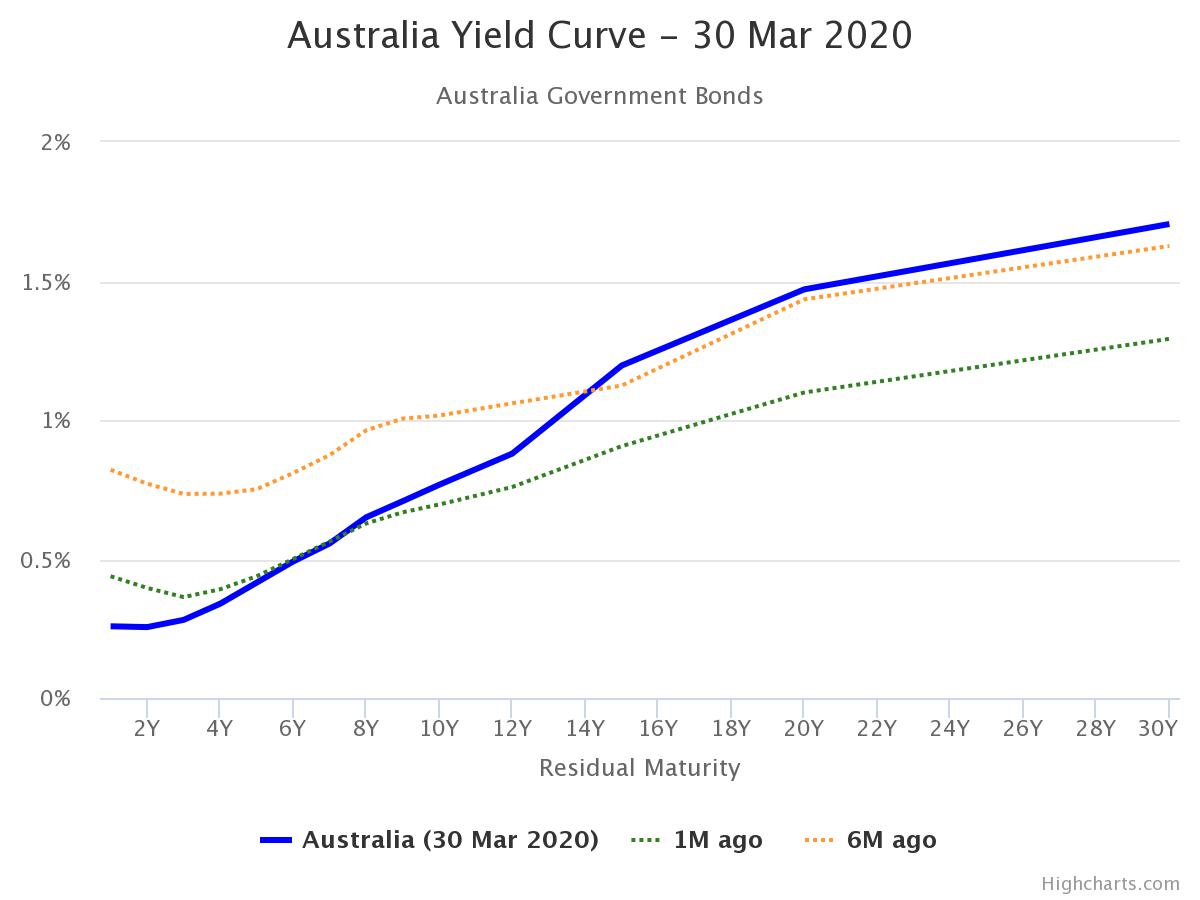

Different orientations of the curve give different hints to what can be expected in the future.

Normal Curve - has a lower short term yield with a mild increase to mid term and long term. This indicates a normal level of confidence about the future.

Steep Curve - has a lower short term yield with a much greater mid and again much greater long term yield. It is a very bullish signal and has historically correlated with rallies in the stockmarket.

Flat Curve - indicates a lack of investor confidence in the future and is a moderately bearish indicator, although not as bearish as the inverted curve.

Inverted Curve - occurs when short term bonds produce a higher yield than long term bonds. This demonstrates that investors are expecting a drop in yields over the long term as well as a high risk in the short term. This is a very bearish indicator and is often portrayed by the media as a sign that a recession is imminent, whether or not that is true is another matter for a separate debate.

Qualitative Indicators

Pendulum of Hysteria and Euphoria - Changing times?


Moving away from the highly technical quantitative indicators, I find that having an understanding of investor mood through qualitative signs is also important in pinpointing where we currently are on the pendulum swinging between hysteria and euphoria.

There are a number of sources that I have referred to, each with their own limitations. The news is an obvious starting point but the media always sells more by playing up the fear factor, so this often ought to be taken with (at least) a grain of salt. Friendly conversation with friends and coworkers can also provide insight into what your peers are thinking, but of course you are narrowing down your sources to your acquaintances which may only represent a small segment of broader society.

A resource that I have found somewhat insightful over the years is Reddit, specifically the subs investing, fiaustralia, ausfinance and wallstreetbets. Although you are also limited to a demographic of people who are clearly computer savvy enough to post and engage with the online community, it provides a less biased account of reality.

A snapshot of some posts on Ausfinance today results in the following:

For those who are reading this post after the fact (which will probably be most of you), the ASX dropped 36% from a peak of 7162 on 20 Feb 2020 to a recent trough of 4546 on 23rd of Mar 2020 and has since rebounded quite violently 13% to 5181 today 31st Mar 2020. Since the initial panic that was caused by the crash which lead to a considerable amount of selling off (see RSI) there have been a notable amount of investors who have joined the bear gang and attempted to recoup losses by way of buying inverse indices such as BBUS and BBOZ or for the more sophisticated traders buying put options. This had been going on for a couple of weeks now and resulted in a number of oversimplified principles  such as "buy puts = free money" "all in BBUS". The mood on the relevant boards quickly changed from despair to euphoria when the masses of retail investors learned that they could grow their wealth at an accelerated rate by using these highly risky, leveraged products.

As mentioned above, we have since experienced a considerable uptick in the last week and the posts in the screenshot provide a good indicator of how the typical retail investor is reacting to this market movement. From hope of a bearish future with the prospect of incoming defaults and further falls anticipated in equities to the user who invested his whole life savings into BBUS and BBOZ it is clear that they are all anticipating further falls in the market. Whether or not we have reached the extreme end of the pendulum is anyone's guess but these posts seem to indicate that even if we haven't, we ought to be fairly close.

Another interesting note on the matter though, traditionally retail investors were not sophisticated enough to buy inverse indices or puts as these products have only been made available to the masses relatively recently. I would suggest that with these products being made available, an adjustment to our pendulum ought to be made to reflect this, since once the market has clearly taken on a downward trend, euphoria can be found in retail investors who have bought inverse indices or puts where traditionally there would only be hysteria. It would seem that now hysteria only really arises when the market turns and those who missed the signals are caught like a deer in the headlights.

Keynesian Beauty Contest

One final qualitative measure that I will touch upon today is the Keynesian Beauty Contest. For those who are unaware, rather than the traditional beauty contest where participants are asked to choose who they consider to be the most beautiful, they are asked to choose who they think will be voted most beautiful, i.e. crowd consensus. In other words, it constitutes a game of sentiment whereby the winner is the person who can guess better than the crowd as to how the crowd will behave.

In applying this back to our current situation with Covid and the lockdown that I find myself in, we have seen not infrequent headlines whereby the crowd has bought into the hype that the shutdown that we face will be ongoing for months on end, tens of millions of people around the world will die from this virus and the markets will never recover ever again. The most important question though is that although this is what the crowd believes will happen, is this likely to be a realistic outcome given our fundamental understanding of human nature? I would argue that it is not.

In closing, I would like to round off this post with some words from, Warren Buffett, “Be Fearful When Others Are Greedy and Greedy When Others Are Fearful”.

by 小福

Thursday, March 26, 2020

Random Musings: Hot Waitresses, Mens' Underwear and Lipstick

Since my last post just under two weeks ago, Australia has plunged into the second stage of a lock down, my work has finally handed down a work from home directive and I haven't left the house in four whole days. Whilst I have been home bound, it has given me ample opportunity to further my studies and readings on finance and the broader economy whilst this volatile situation unfolds.

One of the things that appeared as a recurring theme across books that I had read was sentiment. Essentially that it is important to have a firm understanding and ability to grasp what the market sentiment was so that we could comprehend where we currently are on the fear-greed pendulum. Among all all my technical technical readings I came across three informal measures of sentiment which I came across on Investopedia. All three are quite interesting albeit crude measures. Having taken a look back at my last several posts which have been quite sombre, I thought it would be apt to share these with you to lighten the mood a bit.

Hot Waitresses


So the idea with this measure is that next time you have a meal out, you take a look at your waitress to see if they are relatively good looking or not, because according to the index, the higher the number of good looking waitresses there are, the weaker the state of the economy. The idea behind this is that during times of plenty, attractive people will be able to find and abundance of employment in other jobs. As these jobs become less available during times of crisis, by the laws of supply and demand, they will find themselves in hospitality jobs like waitressing (or waitering).


Image result for anime waitress

Mens' Underwear


Prior to Alan Greenspan's research in the 1970s, mens' underewear was largely viewed as a necessity rather than a luxury, which would mean that sales would largely be static despite a change in the economic climate. However what the research in fact proved was that during times of economic decline, men tended to wear their underwear until it was threadbare rather than get new ones, an interesting contrast to womens' underwear purchase habits. Complimentary to this study, similar results were shown for things like clothing alterations and haircuts. Having said that, I am only privy to the condition of two mens' underwear, being my father and my ボーイフレンド. If you looked at their underwear as a basis to assess the economic climate we are in, you would think we are in a perpetual never ending depression, so my personal anecdotes seem to refute this research.
Image result for boxer shorts muji

Lipstick


Our last informal indicator is lipstick. So rather than having an abundance of fresh crisp new underwear when the economy is booming, women tend to indulge in other luxuries such as designer handbags or outfits. The idea is that when the economy is faltering, women still want to indulge themselves and instead purchase smaller luxury goods as a sign of comfort such as lipstick, which would mean that the higher the lipstick purchases, the worse the economy. Again, if I applied this indicator to my own purchases of lipstick, you would think we never got out of the depression. Either way, it is an interesting way to consider indicators of market sentiment.

Image result for lipstick

By 小福

Monday, March 16, 2020

Trials and Tribulations: Three weeks and 30%

Tuesday 17 March 2020. As I write this, it has been approximately three weeks since the market started to drop and since then my portfolio which is largely index based, has dropped roughly 30%(T_T). Yesterday marked the biggest fall in ASX history at 9.7% and overnight the SP500 lost 12%. Trading halts and massive swings used to be rarities and are now commonplace. The volatility index has risen to 80 and panic has thoroughly set in amongst the broader population∑( ̄□ ̄;). Self doubt has started to creep in on me but my resolve still holds firm. I decided on this course of action four months ago and I intend to see it through to the end._(:3」∠ )_


Indubitably mass hysteria has set in to the general populace, far beyond the financial markets. It is one thing to hear about panic buying of essential goods on the news and another to witness the apocalyptic sight of empty shelves in the supermarket first hand(。•ˇˍˇ•。). Thankfully my household has a heathy reserve of basic necessities. My workplace has not given a directive to work from home or self-isolate, but our organisation appears to be the last stand in a derelict skyscraper. Most of my colleagues are on edge but management refuses to consider the welfare of staff and would rather focus on the bottom line(╯‵□′)╯︵┴─┴.

In the news, I am constantly bombarded with news that large institutional companies like Qantas or UQ are on the verge of going bust as well as predictions of long standing recessions which will take up to ten years to recover from (Deloitte). People whom I respect greatly are predicting a permanent shift in society with far reaching consequences for the long term future and my learnings on holding steadfast to contrarian beliefs are being well and truly tested.( •̥́ ˍ •̀ू )

Only time will tell if I have made the right choice in sticking to my plan, otherwise it will be a very costly mistake indeed.

By 小福

Thursday, March 12, 2020

Trials and Tribulations: End of the Bull Run

With my last post and the slowing down of instances of Coronavirus in China, I had thought that maybe my run of bad luck would finally take a turn and I would be able to recoup some of my (not yet crystallized) losses (-_-) zzZ. Unfortunately for me (and the rest of the world), we took a turn for the worse in the last two weeks and the eleven year bull run was finally brought to an end this with the market in free fall across America and Australia ʕ •ᴥ• ʔ.


As I write this, the S&P500 had lost $5.3tn whilst the ASX200 has lost $430bn in the last three weeks and there has been considerable hysteria online and in real life. Everyone regardless of whether or not they bought into the market has a fairly strong opinion on whether or not the virus will cause long lasting economic impacts as well as the associated impacts and flow on effects╮(︶︿︶)╭. 

For the time being, I have learned to stabilise my own emotional responses to the regular losses with a focus on long term gains as I continue to dollar cost average on a regular basis(-_-;)・・・. I thought I had gotten used to drowning out irrelevant opinions as noise, but today I was fairly shaken by the words of my long time mentor Mr L, who I consider to be the most brilliant men I have ever met. Throughout the years, he has given me priceless insights on the machinations of the world, needless to say, I hold him in extremely high regard. As someone who invests heavily in precious metals, Mr L doesn't touch property or stocks, however as I was speaking with him about other matters today, I did mention that I was buying into the dip as the downturn unfolds, to which he very sternly told me that trying to catch a falling knife is a dangerous endeavour \(º □ º l|l)/. Frankly, I can discount a large majority of people's opinions and continue my course of action because I consider them to be wrong, but when my most respected mentor also raised these concerns, I definitely faltered in my conviction and spent the whole afternoon pondering my choices. In the end, I've committed myself to going through with this and until I see definitive proof that the strategy doesn't work, I will see it through, but it is definitely taking a lot more determination than I had previously estimated. Hopefully in a few months, this will not matter anymore(×_×)⌒☆.

In the meantime, this is what I think of bears\\٩(๑`^´๑)۶//:


By 小福

Saturday, February 29, 2020

Trials and Tribulations: Coronavirus Market Correction

With the drama that I had experienced most recently with my only two hot picks in individual stocks, CLH being on its continued trading halt which has now extended until mid March and UNV being subject to a hostile takeover bid from TER, I really thought that I had seen enough drama to last a year. (ᗒᗩᗕ)

That is, until the markets this week undertook one of the biggest corrections in recent times with the index going down 9.8%, taking $210bn from the markets   ᕕʕ •ₒ• ʔ୨. As someone who doesn't buy shorts or puts, obviously I took on a fair amount of collateral damage.


As someone who tried to go into this journey with a certain amount of mental preparation, I too was caught off guard as to my personal responses to this black swan event. Early on in the week, my ボーイフレンド and I spent most of it indulging ourselves in schadenfreude when we watched everyone around us and in online forums lose their minds over the daily 3% drops Σ(・ω・ノ)ノ! . It had gotten so bad that even my colleague Mr D was finally pushed over the edge and cashed out his holdings on Thursday and dived in on inverted indexes (BBUS and BBOZ), cashing out at the lowest point, thereby crystallizing his losses before buying into the already relatively higher inverted index. I can only hope that he doesn't crash and burn too hard that he can no longer be redeemed.

As for myself, I had high hopes that with my mental preparation, I would be able to separate myself from the numbers as the fell. During the start of the week, I could definitely say that I managed to do so with relative capability. Having said that, by the end when it neared a 10% drop, I too succumbed to a slight bout of sadness when I realised that half a years' worth of my savings was gone on the papers. When you consider than in real terms of how many bleary eyed mornings I had to force myself out of bed to get onto the bus and deal with stupid people at work, it did make me fairly sad. Despite my disappointment in myself for having feelings when I expected none (◞ ‸ ◟ㆀ), I can still gladly say that I did not once have my finger on the "sell" button, which is testament at least to a level of discipline and rationality.

Image may contain: food

So to drown our sorrows for losing that much on the markets this week, at least we could still enjoy two minute noodles and tendies to commemorate our week of losses. As for what I will be doing next week? I will be increasing my DCA and putting my March funds into WGB. For those who are wondering, I couldn't convince Mr A to go buy in the dip, but at least he also stayed the course and is continuing his regular investment ʕ´•ᴥ•`ʔσ”.

An interesting note though, as an ironic silver lining to this week, the trading halt from CLH happened to cushion my fall a bit, cos 0% is still better than being negative. 

By 小福

Sunday, February 16, 2020

Trials and Tribulations: CLH Trading Halt

Having only started my portfolio a mere three months ago, I had expected a fairly uneventful first few months with most of the excitement in my life attained from second hand thrills in watching what goes on in Mr D’s portfolio as well as the shenanigans on r/wallstreetbets⊙﹏⊙∥. The vast majority of what I personally hold are of course a collection of conservative and uninspiring ETFs, which of course leads to the conclusion that a minority of my holdings are comprised of individual stock picks (≧ω≦)/.

I had initially wanted to write a brief analysis post on my first ever hot pick, Collection House (ASX.CLH), but whilst I was still formulating what aspects to cover, an interesting development occurred in the meantime in the form of a Trading Halt to CLH. Σ(っ °Д °;)っ

As someone who has long been fairly risk adverse, I thought that I would be moderately stressed out by the uncertainties pertaining to the trading halt. With Mr D having mentioned to me a number of times that he believed CLH to be a textbook example of a value trap that he believes will slowly drop in price to eventual oblivion, this was largely founded upon a lack of understanding of the industry that CLH operates in as well as assumptions and speculations on management which appear to be largely unfounded based on my preliminary research (。・`ω´・).  Contrary to my apprehension though, since being notified of this last Friday, my mood has been relatively uneventful despite the unpredictability in what may happen when the Trading Halt either lifts on Tuesday or gets extended. For now, we have no information as to whether or not to expect good or bad news from the halt.

Reflecting on this, I would have to attribute my serenity to the copious amounts of time my ボーイフレンド  and I spent  delving through years of annual reports and financial reports of not only CLH but also its competitors, assessing the potential risks and threats to the business before deciding to put our hard earned money into the company(•̀へ •́ ╮ ). Having been satisfied that it was a reasonable purchase for good value with a solid history of dividend yield and potential for future growth meant that even when a Trading Halt was placed on the shares, I found little to shake my conviction in my decision making.

In short, if I am right in my reasoning of the outcome, there is little to be concerned about come the announcement tomorrow and if I happen to be wrong, it would be a most interesting albeit costly lesson to have learned. Will provide an update as the situation resolves. ٩(๑`^´๑)۶

By 小福

Wednesday, February 5, 2020

Random Musings: On the GFC, Trading Cards and Maplestory

Whilst I was reading A Crisis of Beliefs, one of the things that really stuck with me was the fundamentals of what causes a financial meltdown. Reflecting on my relative inexperience in life, it occurred to me that similar situations had happened to me before but in a different context (。T ω T。). Speaking to my ボーイフレンド , he too provided a story pertaining to his similar experiences which basically summarizes the GFC perfectly (。•́︿•̀。) . I will try to encapsulate them below.

Image result for sailor moon trading cards

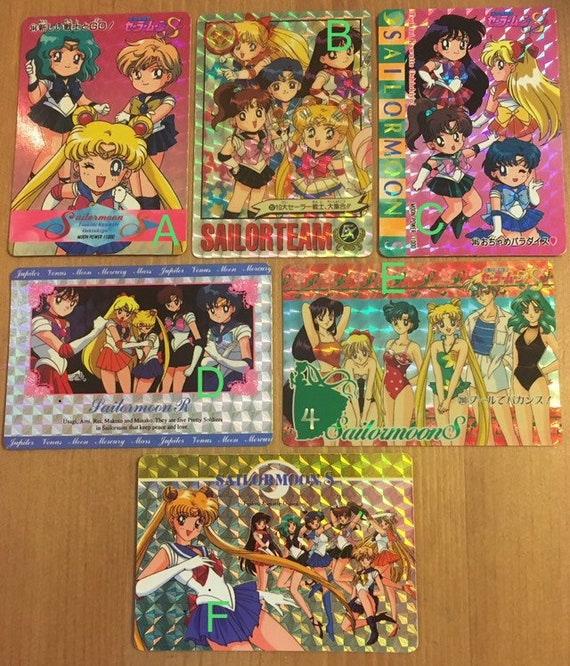
In my childhood, I used to be a huge fan of Sailor Moon trading cards, subsequently amassing a large collection of cards which were my pride and joy. At some point, I met up with a distant cousin over a meal, and as all young children are prone to do, I showed her my stash of cards. At this point, she told me that she had a hot tip that a certain card that she held was worth $50 (a fortune to a seven year old), which was more than enough to drastically multiply my collection, all for a discounted family rate of my best card凸( ` ロ ´ )凸. As all dumb seven year olds would do when presented with this offer, I jumped on it. Only several days after the fact when I asked around to find a way to sell off the card to expand my collection was I informed by my parents that what I was given was a plain piece of cardboardヽ(`⌒´メ)ノ . 

Image result for 楓谷 卷軸 npc

My ボーイフレンド 's experience was similar but different. Back in the early days of the highly popular MMORPG Maplestory, he was sold an enhancement scroll for $1.5m gold on the premise that he was getting a discount from the regular $2m market value. Again, as children are oft to do, he made the purchase. Luckily for him, he onsold it to another unsuspecting buyer for a profit, only to realise later that these scrolls could be purchased at an unlimited quantity from the game itself for the small sum of $34k. ¯\_(ツ)_/¯

In essence, the economy as we know it is a giant marketplace of people conducting individual trades every single day. For every transaction there is a seller, a buyer and an agreed price. For market crashes to happen, the players often get so hyped up in the perceived value of an asset completely deviates from the true value. Those who are lucky can pass it on to another buyer, those who aren't lucky when the ball drops are left with a piece of cardboard (`皿´#).

By 小福

Book Review: A Crisis of Beliefs - Nicola Gennaioli and Andrei Shleifer

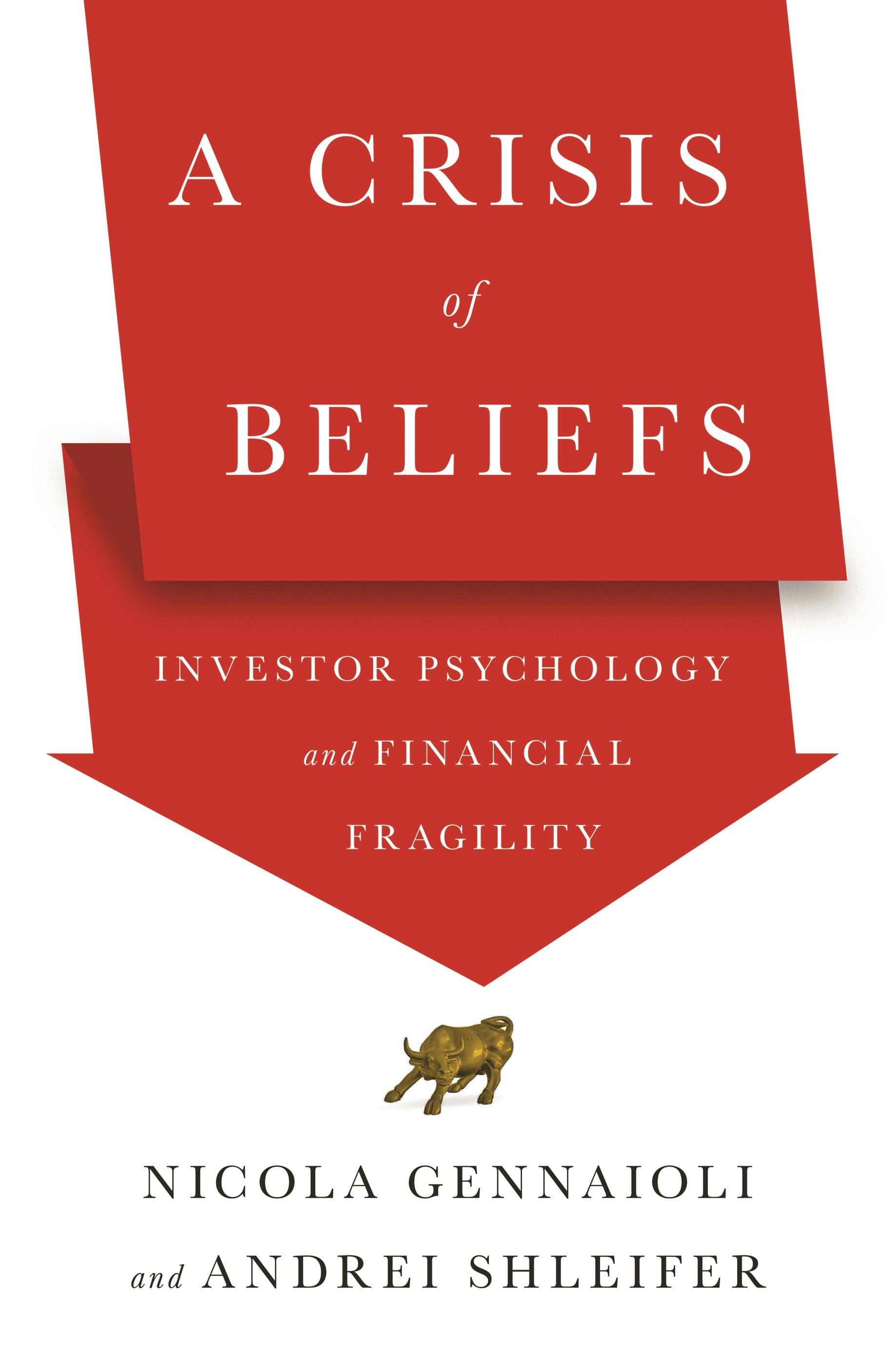
One of the first concerns I had to contend with before putting a considerable portion of my life savings into the stock market was the potential for market downturns. Having lived through the GFC, I was keen to have an understanding of the factors that lead to the last market crash, which is why "A Crisis of Beliefs" by Nicola Gennaioli and Andrei Shleifer caught my eye, so I had to check it out (✧ω✧) .

Image result for a crisis of beliefs

Basically the book creates a fairly complex mathematical model demonstrating how a failure to consider the downside risk coupled with financial fragility resulted in the crash that was the GFC. Although I found the book to be fairly technically advanced in its concepts and  formulas, I did appreciate the fundamental concepts it was based upon though.

In short, failure to consider downside risk means that the majority of the players in the market before the crash didn't give enough due consideration to what would happen in the worst case scenario (⇀‸↼‶). Tying it back to the principles of value investing, it would mean that you should always be certain of the true value of what you are buying rather than just joining in on mindless hype. As an analogy, say you bought shares of a farm, even if the paper value of the farm crashed to zero, you would still hold a (hopefully) revenue generating asset.

The second factor that was covered in the book related to financial fragility, specifically pertaining to how interconnected the components of the market are and how the failure to consider downside risk can lead to a death spiral of credit contraction, loss of liquidity and eventual crash (`ー´) .

Although I felt a little out of my depth reading this book, I found the basic gist of it easy enough to understand, and it will probably be a book that I return to when I am a bit more advanced in my studies.
By 小福 

Thursday, January 30, 2020

Random Musings: On debt and stimulus

Have just started reading Big Debt Crises by Ray Dalio two days ago. For those who aren't aware, it is a 480 page tome, (๑・▱・๑) which will take at least a number of weeks to smash through, let alone digest the insights, but reading the first part of the book gave me some time to ponder the debt crisis that I had lived through, specifically the GFC which Australia emerged out of relatively unscathed.

Image result for paper

It was on this point that I was having a discussion with my colleague Mr A today, who remarked that when Labor passed the stimulus package of February 2009 which famously handed out $950 per person was widely criticized by the liberal party but 10 years on in the face of another potential recession, the Morrison Government passed their tax cuts which essentially did the same thing. It is however noteworthy to highlight the differences, in the two situations though. Back in 09, the world was thrust into a financial crisis of significant magnitude whereas we appear to be currently facing a slow burnout. Secondly, the stimulus package from 09 also ensured that those who were most likely to spend the money immediately (i.e. those on welfare or aren't working) had received the payment, whereas the Morrison Tax Offset only comes into play for taxpayers on $37,000 and above. There is no wonder why the tax break didn't bring the intended effects to consumer spending.

With that in mind, I have to give credit where credit is due, and although I have definite disagreements with Wayne Swan on his morals and ethics pertaining to the subsequent leadership debacle(s), one cannot deny that he was a brilliant treasurer who navigated the country out of a precarious debt situation.

I can only hope that when the next crisis does come, I will be educated enough to navigate a safe path for myself and those around me. Until then, I will keep reading. (๑•́ ω •̀๑)

By 小福

Sunday, January 26, 2020

Random Musings: On character and competitiveness

Human nature is one of the few things that I have developed a life long passion for. There are few things that bring me as much joy as observing how different people respond in a variety of manners to the same stimuli.(〃・ω・〃)

Having embarked on this journey of personal investing, I have found it to be surprisingly interesting to observe how other people make their decisions an the reactions they have from the subsequent results.

As such, I consider it noteworthy to narrate a certain saga that had occurred before me quite recently, more or less in response to my ボーイフレンド's current state of affairs and the reactions of two colleagues, Mr A and Mr D. It is without a shadow of a doubt to me that Mr D is the more intelligent and accomplished of the two, but with a streak of competitiveness and a desire to outperform others, he has of late undertaken a number of risky ventures without due consideration, some of which have resulted in bad outcomes which have put him further away from where he wanted to be. Coupled with an inability to accept good counsel when offered, this has drawn him down the dark path of inevitable destruction (or at least perpetual unhappiness)( ̄^ ̄). By contrast, Mr A who I consider to be less smart, but aware of his shortcomings, of good character and sincerity had been inspired to do better and undertaken several small but significant adjustments to his lifestyle with a slow and steady approach to securing his financial future without a hint of bitterness but genuine desire to further his goals ヾ(。・ω・)シ. It would appear to me that even though after several decades, Mr D may still amass a greater fortune than Mr A, there is no question of who would attain a greater quality of life.  One can only hope Mr D sees the light before it is too late. ¯\_(ツ)_/¯

In closing, it cannot be overstated enough the importance of staying humble and pursuing your life and goals at your own pace, without being misguided by the green eyed monster. Seeing someone who has achieved greater than you can be used a s a source of aspiration and motivation to extend yourself and do better, but if it leads you to irrational decisions in a bid to attain superiority, then a self aware individual ought to identify and cease this behaviour, for only with self reflection can we recognise and overcome our own demons. (*•̀ᴗ•́*)و ̑̑

“Rule 4. Compare yourself to who you were yesterday, not to who someone else is today" 
- Jordan Peterson's 12 Rules for Life.

By 小福

Friday, January 24, 2020

Achievement Unlocked! First Dividend

So there has been quite a bit of fluctuation on the stockmarket in the last couple of days. Daily ups and downs have easily come to a couple days salary on my part. It has been a learning experience, to say the least, in my moderating my actions and reactions to these movements. _(:3」∠ )_

More than once, I've had friends and co workers say to me "The market is up, let's go eat out at somewhere nice tonight" for me to reply "Its not a true earning until you cash out, and even then, the tax man has to take a cut first". As anticlimactic as it sounds, I dont think that you can really consider yourself as having earned the money until it has been liquidated.

Anyway, the point though is that coming home from work today, I received a nice surprise in the mail (๑•̀ω•́๑). My first dividends ever *\(^o^)/*. So although I can't consider market volatility as being my gains, dividends are most certainly mine.

Will I go out and get a nice dinner with it though? No. Will I be a sensible girl and reinvest it in the market? Also no 乁( ˙ω˙ )厂

I already went and spent it all on a birthday gift for my ボーイフレンド , in my opinion, the best investment of them all.

By 小福

Tuesday, January 21, 2020

Book Review: The Intelligent Investor - Benjamin Graham

I guess I will start off the first substantial post with a quick note on one of the first books I read when embarking on this journey, being the Intelligent Investor, by Benjamin Graham. Apparently this is known to be the bible of investing, and Graham is known as the father of value investing.

Related image

So my understandings of value based investing based upon reading the tome over the span of three weeks was largely about the importance of purchasing large common stocks when they are undervalued or have fallen out of favour with the general public. Paramount to this is asking yourself every time before you buy something whether or not you are getting good value for money and whether or not the asset you purchase is safe enough to retain value or has the potential to crash into oblivion.

Another albeit obvious finding that it pointed out was the duality of identity that comes with stock ownership. Simply put, when one becomes an owner of shares, you become a part owner of a business on one hand and also the owner of a (hopefully) appreciating asset. More than not it would seem that most investors tend to focus on the second identity and often forget the first. It just so happened today that I was reminded of this when I received a voting form in the mail today, the first I had ever received, which reaffirmed to me that as much as I hold very little to make much difference in any voting outcomes, it is still a good reminder that in making that purchase, I probably ought to take a stronger interest in the prosperity of the business whilst I still hold the equities.

Although these aren't particularly sophisticated or groundbreaking insights, they make for a solid foundation that I hope I do not forget in the pursuit of this venture.

By 小福

Monday, January 20, 2020

First Post

In this blog, I aim to discuss my learnings and insights as I learn personal investing.

Initially, I had little intention to start writing on this topic, but my ボーイフレンド  was fairly persuasive on this matter and I consider it to be a good opportunity to go back and reinforce things that I learn and to document my evolution in thinking.

As I read books and gain experience on the subject, I will update on my thoughts, opinions and reflections on the matter as I progress with my studies.

For anyone wondering why cappuccinos, I just really enjoy coffee (๑•̀ᄇ•́)و ✧

By 小福